
 The Bhagavad Gita is one of the holiest books of Hinduism.[1] The Bhagavad Gita (romanized: bhagavad-gītā, lit. 'The Song by God'), often referred to as the Gita (IAST: gītā), is part of the ancient Hindu epic Mahabharata. It is considered to be written in the first millennium BCE. It has teachings said to be given by Sri Krishna, who is considered a Supreme divine being. In the book (Bhagvat Gita), Krishna answers questions from Arjuna, a Pandava prince, about a human's moral duties (called dharma) regarding a broad range of philosophical and metaphysical matters.
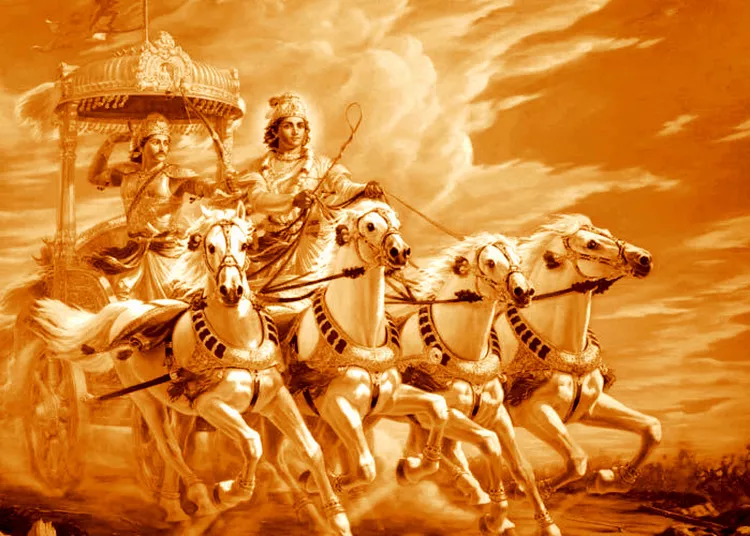
The Bhagavad Gita is set in a narrative framework of a dialogue between the Pandava prince Arjuna and his charioteer guide, Krishna. At the start of the Kurukshetra War between the Pandavas and their cousins, Kauravas, Prince Arjuna is in doubt, thinking about the violence the war will cause.[2] Wondering if he should renounce the war, Arjuna seeks the counsel of Krishna, whose answers and their discourse constitute the Bhagavad Gita. Krishna counsels Arjuna to "fulfill his warrior duty" for the upholding of dharma.[3] The Krishna–Arjuna dialogue covers a broad range of spiritual topics, touching upon moral and ethical dilemmas, and philosophical issues that go far beyond the war that Arjuna faces.[4][5][6]
The Gita posits the existence of an individual self (Atman or Soul) and the supreme self (Brahman or Supreme Soul) within each being. The dialogue between the prince and his charioteer has been interpreted as a metaphor for an immortal dialogue between the human self and God. The text covers the philosophy of Yoga in terms of Gyan (Knowledge) yoga, Bhakti (devotion) yoga, Karma (action) yoga, and Rāja (governance) yoga,[7].
The Bhagavad Gita is one of the holiest books of Hinduism.[1] The Bhagavad Gita (romanized: bhagavad-gītā, lit. 'The Song by God'), often referred to as the Gita (IAST: gītā), is part of the ancient Hindu epic Mahabharata. It is considered to be written in the first millennium BCE. It has teachings said to be given by Sri Krishna, who is considered a Supreme divine being. In the book (Bhagvat Gita), Krishna answers questions from Arjuna, a Pandava prince, about a human's moral duties (called dharma) regarding a broad range of philosophical and metaphysical matters.
The Bhagavad Gita is set in a narrative framework of a dialogue between the Pandava prince Arjuna and his charioteer guide, Krishna. At the start of the Kurukshetra War between the Pandavas and their cousins, Kauravas, Prince Arjuna is in doubt, thinking about the violence the war will cause.[2] Wondering if he should renounce the war, Arjuna seeks the counsel of Krishna, whose answers and their discourse constitute the Bhagavad Gita. Krishna counsels Arjuna to "fulfill his warrior duty" for the upholding of dharma.[3] The Krishna–Arjuna dialogue covers a broad range of spiritual topics, touching upon moral and ethical dilemmas, and philosophical issues that go far beyond the war that Arjuna faces.[4][5][6]
The Gita posits the existence of an individual self (Atman or Soul) and the supreme self (Brahman or Supreme Soul) within each being. The dialogue between the prince and his charioteer has been interpreted as a metaphor for an immortal dialogue between the human self and God. The text covers the philosophy of Yoga in terms of Gyan (Knowledge) yoga, Bhakti (devotion) yoga, Karma (action) yoga, and Rāja (governance) yoga,[7].
The Bhagavad Gita is one of the holiest books of Hinduism.[1] The Bhagavad Gita (romanized: bhagavad-gītā, lit. 'The Song by God'), often referred to as the Gita (IAST: gītā), is part of the ancient Hindu epic Mahabharata. It is considered to be written in the first millennium BCE. It has teachings said to be given by Sri Krishna, who is considered a Supreme divine being. In the book (Bhagvat Gita), Krishna answers questions from Arjuna, a Pandava prince, about a human's moral duties (called dharma) regarding a broad range of philosophical and metaphysical matters.
The Bhagavad Gita is set in a narrative framework of a dialogue between the Pandava prince Arjuna and his charioteer guide, Krishna. At the start of the Kurukshetra War between the Pandavas and their cousins, Kauravas, Prince Arjuna is in doubt, thinking about the violence the war will cause.[2] Wondering if he should renounce the war, Arjuna seeks the counsel of Krishna, whose answers and their discourse constitute the Bhagavad Gita. Krishna counsels Arjuna to "fulfill his warrior duty" for the upholding of dharma.[3] The Krishna–Arjuna dialogue covers a broad range of spiritual topics, touching upon moral and ethical dilemmas, and philosophical issues that go far beyond the war that Arjuna faces.[4][5][6]
The Gita posits the existence of an individual self (Atman or Soul) and the supreme self (Brahman or Supreme Soul) within each being. The dialogue between the prince and his charioteer has been interpreted as a metaphor for an immortal dialogue between the human self and God. The text covers the philosophy of Yoga in terms of Gyan (Knowledge) yoga, Bhakti (devotion) yoga, Karma (action) yoga, and Rāja (governance) yoga,[7].